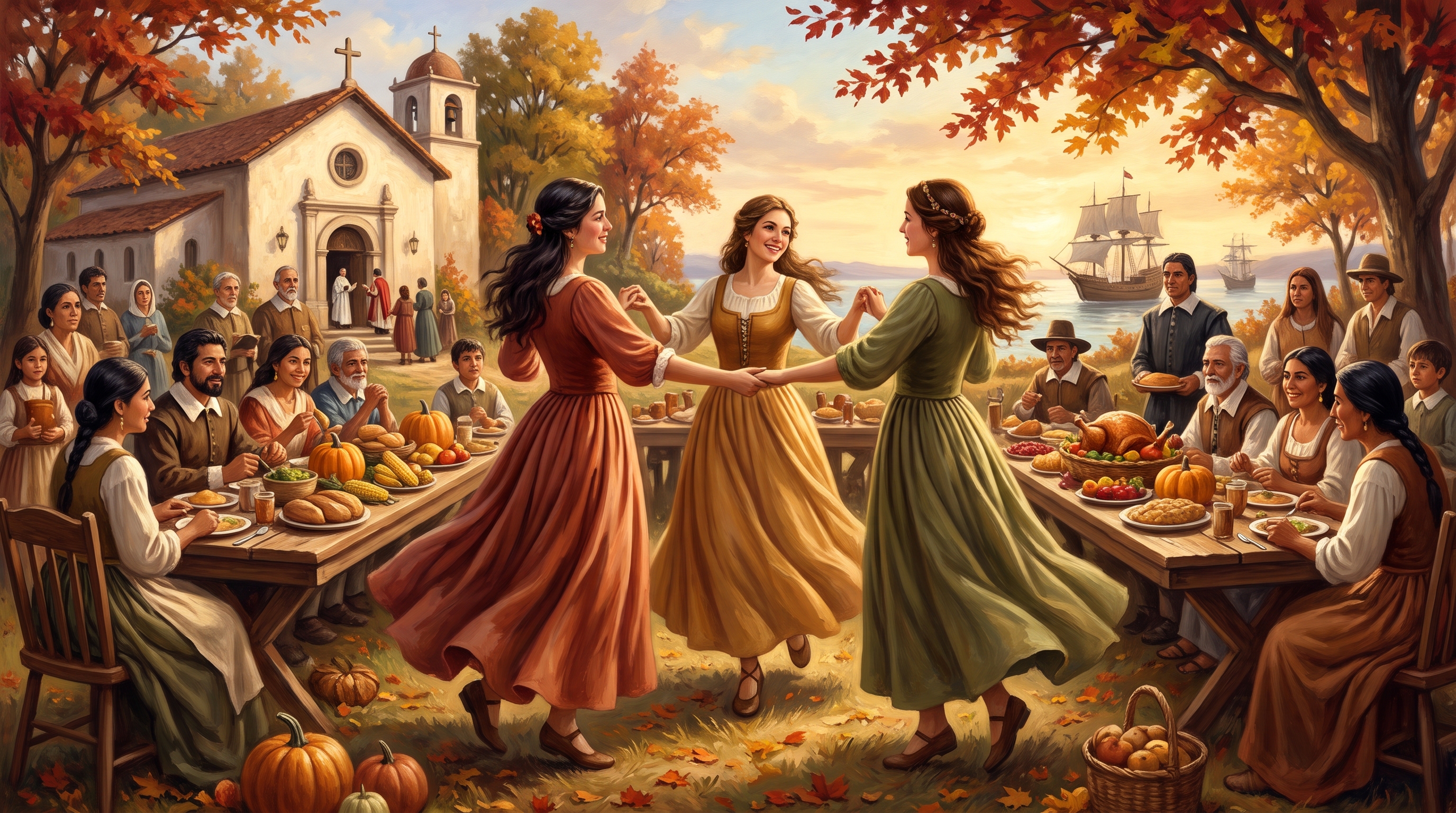
In the United States, we celebrate THANKSGIVING DAY on the last Thursday of November each year. It is the country’s principal annual holiday and traces its historical roots to a harvest feast that gave thanks, and that was held in the autumn of 1621 in Plymouth Colony (present-day Massachusetts), when a group of English settlers, known as “the Pilgrims,” who had arrived aboard the Mayflower a year earlier and survived a devastating winter, had persevered with the help and solidarity of the Wampanoag people.
The transformation into the national holiday we know today unfolded through several stages in the history of this nation and through various interpretations, ranging from the mythical Thanksgiving encounter described above to the mourning of Indigenous communities for the devastation and losses they subsequently suffered at the hands of European colonization.
But the important lesson has endured through four centuries: the importance of being grateful, of giving thanks. Whoever expresses gratitude, whoever gives thanks, first acknowledges that they have received something freely. This acknowledgment sets us all on the path toward the promise and the duty of completing and closing the circle of the Three Graces: freely giving back the gift that was freely received; in this way, the dance of gratitude continues, never stopping.
The celebration of THANKSGIVING DAY, so closely intertwined with American identity, invites us to reflect on, evaluate, and remember the light and shadows that make up our history as a nation, both to give thanks for all that we have accomplished and to work together to address and overcome our historical debts.
Among the great historical achievements we have inherited, for which we can give thanks, are the institutional and democratic experiment that we represent as a nation and that has served as a model for democratic systems around the world. Also among them are the movements of peaceful struggle for civil rights that enabled us to achieve the abolition of slavery, women’s suffrage, and the civil rights movement of the 1960s. Also deeply valuable are the great scientific and technological advances and transformations we have achieved, which today represent progress for all of humanity, along with the capacity for welcome and social integration that we have demonstrated toward migrants who have come from every corner of the earth.
But there are also shadows, because there is a human and social cost upon which the greatness of this nation has been built. These are contradictions and wounds we must overcome, such as systemic racism, foreign interventionism, the dispossession of Indigenous peoples, social inequality, political polarization, and so on.
The community of 65 million Hispanics living in the United States, for its part, is building cultural integration through the redefinition of customs and traditions.
Historically, even before the aforementioned celebration by the Pilgrims, Spanish explorers had already celebrated and documented formal Thanksgiving events in the territory that is now the United States. For example, in 1565, Pedro Menéndez de Avilés and the Spanish colonists shared a Mass of thanksgiving and a meal with the Utina people in St. Augustine, Florida, and in 1598, Juan de Oñate and his expedition held a Thanksgiving ceremony on the banks of the Rio Grande, near San Elizario, Texas.
The foundational story of what we know today as THANKSGIVING DAY, which tells of families who emigrated to these lands in search of a better future, facing hardships and adapting to new circumstances in unfamiliar territories, resonates deeply with the spirit and lived experience of the contemporary Hispanic community.
THANKSGIVING DAY, then, brings us all together for a human and beautiful act: giving thanks for all the good we have experienced and received. But at the same time, it commits us all, every day, to continue giving, to continue building a society with spaces and reasons for hope and gratitude, so that the dance in the circle of the Three Graces does not stop, so that thanksgiving endures, and so that we may celebrate THANKSGIVING DAY with truth and meaning.